






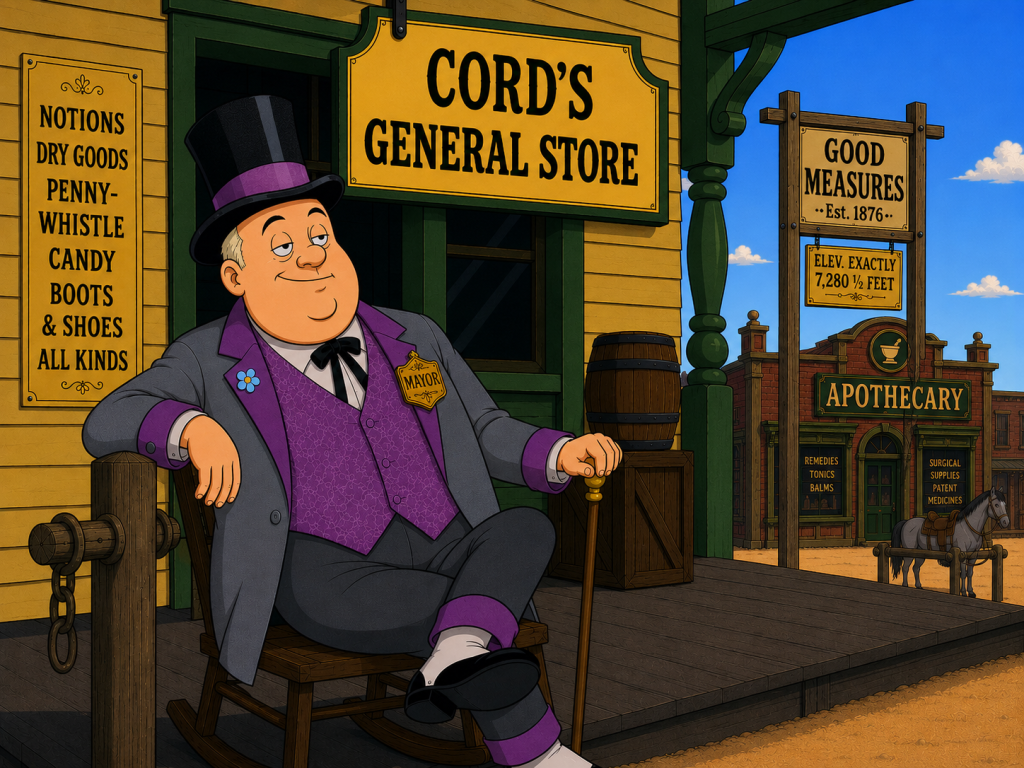
 MAYOR WC GOODMETER
A puff‑chested buffo baritone with a raspy delivery and a fondness for the sound of his own voice, Mayor WC Goodmeter looks every inch the civic authority of Good Measures—at least at a glance. This raspy misanthrope bears a remarkable resemblance to W.C. Fields of early films. He sports a gray three‑piece suit trimmed in smoky purple, complete with top hat, spats, a badge of office, and a light blue flower perched jauntily on his other lapel. His movements are brisk, his speech punctuated with asides, and his expressions are as theatrical as his pauses.
A fast‑talking egoist with a professed disdain for people, pets, children, and most social conventions, WC is nevertheless oddly likable. Unlike his more acerbic inspirations, his sharp remarks are carefully softened—punny rather than biting, blustery rather than cruel. If he ever sounds truly rough, it’s only in muttered comments the other characters conveniently fail to overhear. Despite himself, he often comes across as surprisingly sympathetic.
A descendant of one of the town’s founding families—the Goodmeters—WC holds the office of mayor by inheritance as much as merit. While he enjoys making speeches tremendously, he is not especially skilled at governing, nor terribly troubled when someone gets the better of him. He takes most setbacks in stride, often rebounding with a shrug, a quip, or another speech.
He is especially fond of making speeches about his birthplace and teaching visitors the town anthem, “Good Measures.” He often has trouble getting a word in edgewise, often surrounded by excited neighbors and townsfolk rendering his attempts at speech making useless. But he either takes it all in stride when it works in his favor or expresses complete frustration when it doesn’t.
Once fond of drink, WC was thoroughly reformed under the watchful eye of his formidable mother, Granny Gospel Goodmeter, after she cleaned up The Sonata Saloon. Though he irritates her moral sensibilities regularly, the dynamic between them is more comic than combative—Granny serving as his immovable moral anchor, much like a folksy guardian of tradition, and WC knowing full well when not to push his luck.
WC’s favorite pastime is “bird watching,” which consists of observing the ladies of the town as they pass—particularly saloon girls or notably charming women. Chief among his interests is Amaryllis O’Shea, whom he is convinced he will one day marry, though it remains debatable whether he fully understands what love entails. Even so, his admiration of her is echoed by JP, Rock, and Hurdy who delight in serenading her with Sweet Amaryll. He is also the proud father of Sweet Harmony Goodmeter, whose goodness both baffles and delights him.
Boastful without being cruel, pompous without being dangerous, and endlessly convinced of his own importance, Mayor Goodmeter blusters through life slightly off‑key—never quite in control of the town but always convinced he ought to be conducting.
